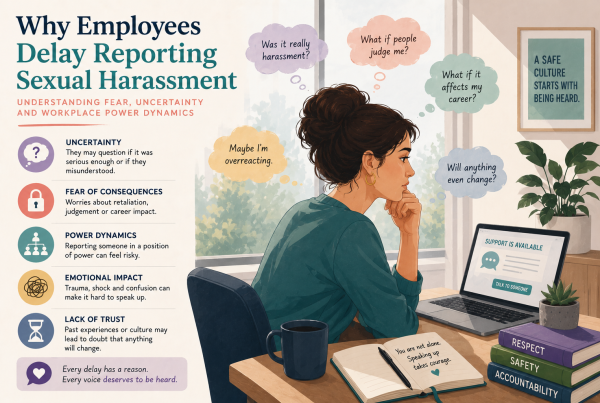
Most organisations say they want employees to speak up.
Policies are written, reporting channels are introduced and leaders encourage people to raise concerns when something does not feel right.
But the real test of speak up culture does not sit in a policy.
It happens in the moment someone actually raises a concern.
In my experience working with organisations on workplace behaviour and investigations, the first response a leader gives can unintentionally shape what happens next. Often that response is instinctive. It may come from loyalty to a colleague, discomfort with the situation or simply a desire to reassure.
But those first few minutes of conversation matter.
They can either build trust and curiosity or signal that the concern is already being dismissed.
In this article we explore why the first response matters, the common traps leaders fall into and what HR can do to help managers handle these moments better.
The moment that shapes speak up culture
Speak up culture is often discussed in terms of systems.
Whistleblowing policies.
Hotlines.
Formal reporting processes.
These structures are important. But they are not what employees usually experience first.
In most cases concerns are raised in a much more informal setting. A conversation with a line manager. A discussion with a senior colleague. A quiet moment after a meeting.
In those first moments the leader’s reaction sets the tone.
If the response feels curious and open, the employee is more likely to feel heard and continue the conversation.
If the response feels defensive or dismissive, the opposite can happen. The individual may quickly conclude that raising the issue further will not lead anywhere.
This is why the first response matters so much. Speak up culture is often shaped in the first few minutes of a conversation.
Employees notice these signals carefully. They watch how leaders respond when concerns are raised and adjust their behaviour accordingly.
The responses that quietly shut complaints down
Most leaders do not intentionally dismiss concerns. In many cases they are simply responding instinctively.
However, certain phrases appear frequently in early conversations about workplace complaints.
For example:
Defending reputation
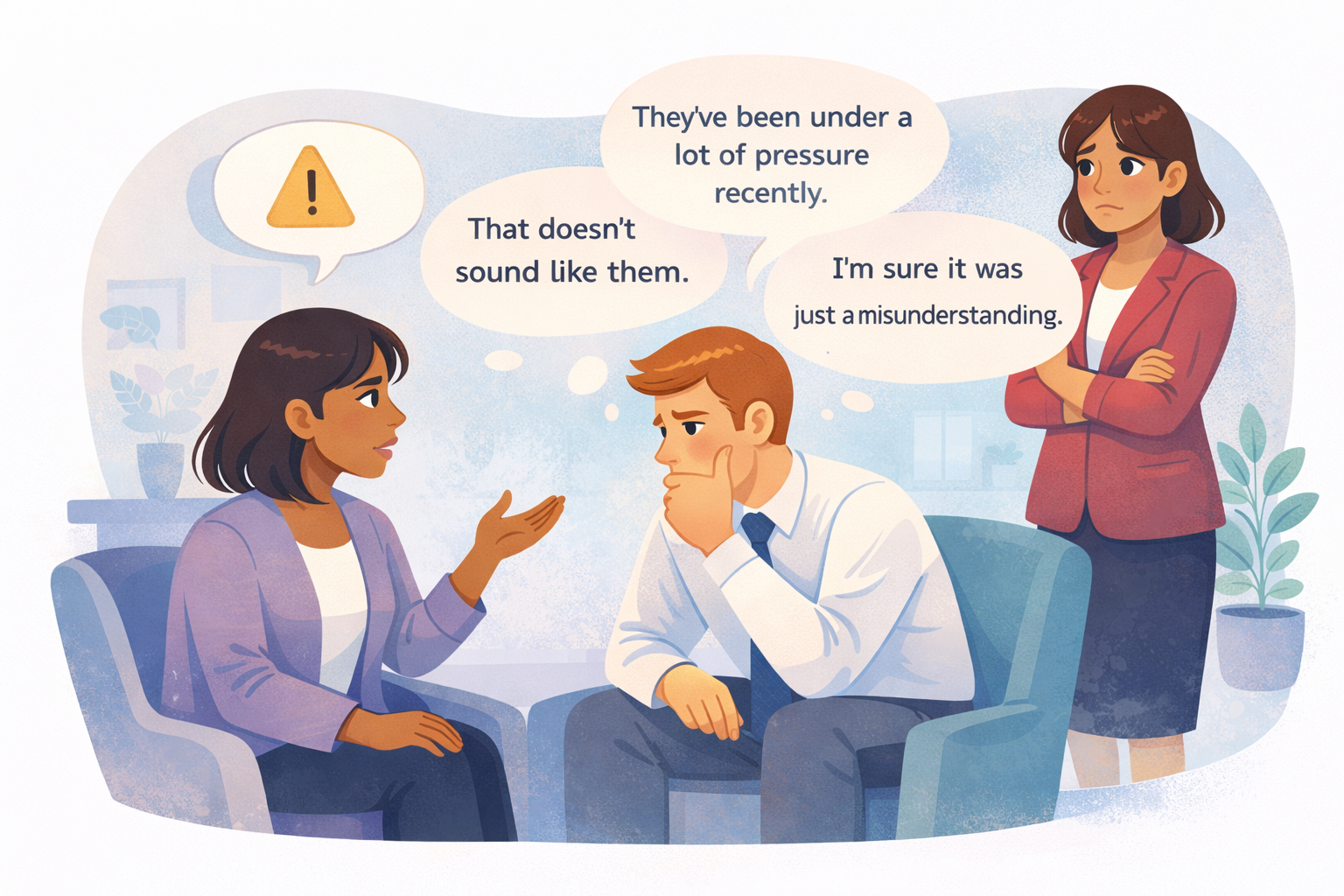
• “That doesn’t sound like them.”
• “I’ve worked with them for years and never seen that behaviour.”
• “They’re one of our strongest leaders.”
Minimising the issue
• “I’m sure it was just a misunderstanding.”
• “It probably wasn’t meant that way.”
• “These things happen in busy environments.”
Explaining the behaviour
• “They’ve been under a lot of pressure recently.”
• “Things are stressful for everyone right now.”
Discouraging escalation
• “Are you sure you want to go down that route?”
• “Do you really want to make this formal?”
None of these responses are necessarily malicious. Often they are attempts to reassure or resolve the situation quickly.
But to the person raising the concern, they can signal something else entirely.
That the leader has already taken a position.
When that happens the focus shifts away from understanding the issue and towards defending the person involved.
Reputation can be powerful in organisations. But reputation is not evidence. Different people can experience the same behaviour very differently depending on context, hierarchy and power dynamics.
Why leaders fall into these traps
There are several reasons leaders fall into these response patterns.
First, loyalty and familiarity. Leaders rely on their own experience of colleagues when forming views. If someone has always appeared professional and capable, it can be difficult to reconcile that image with a complaint.
Second, discomfort with conflict. Many leaders want to resolve issues quickly and restore harmony within the team. Minimising the issue can feel like a way to calm the situation.
Third, commercial pressure. In some cases the person involved may be a high performer or someone the organisation relies on. Leaders may instinctively protect individuals who are perceived as valuable.
Finally, lack of training. Many managers have never been taught how to respond when concerns are raised. They react as colleagues rather than as leaders responsible for ensuring concerns are examined fairly.
Understanding these dynamics is important. The goal is not to criticise leaders but to recognise how easy it is to fall into these patterns.
The role HR plays in preventing the first response problem
For HR teams, the challenge is that they are rarely present when the first conversation takes place.
Concerns are often raised directly with managers or senior colleagues before HR becomes involved.
This means HR cannot control every conversation. But HR can influence how leaders approach these moments.
For example through:
• training managers on how to respond to concerns
• reinforcing the importance of neutral responses
• clarifying when concerns should be escalated
• supporting leaders who find these conversations uncomfortable
This is not simply a compliance issue. It goes directly to organisational culture.
When leaders respond well in these moments, employees are far more likely to trust that concerns will be handled fairly.
When someone raises a concern at work, the goal of the first conversation is not to solve the problem immediately.
It is to create enough trust for the issue to be understood properly.
Leaders can do this by focusing on a few simple principles.
Start with appreciation
Acknowledge that raising concerns can be difficult.
Examples include:
• “Thank you for raising this.”
• “I appreciate you bringing this to my attention.”
Stay curious
Focus on understanding the situation rather than reaching immediate conclusions.
• “Can you tell me more about what happened?”
• “Help me understand the situation.”
Avoid defending individuals immediately
Reputation should not shape the initial response.
Focus on facts rather than interpretation
Understanding what happened is more important than explaining it away.
When leaders approach conversations with curiosity rather than defensiveness, they create space for concerns to be examined properly.
Speak up culture is not defined by policies alone. It is defined by how leaders respond when concerns are raised.
Those first few minutes of conversation can determine whether an employee feels heard or dismissed.
For HR leaders, the challenge is ensuring managers are equipped to navigate these moments well.
Because sometimes the biggest barrier to speaking up is not the complaint itself, but how the first response makes people feel.
At Tell Jane, we help organisations develop the skills and resources to handle workplace grievances before they escalate, creating the conditions for concerns to be raised early, addressed fairly and resolved with confidence.