Understanding Fear, Uncertainty and Workplace Power Dynamics
One of the questions that still appears surprisingly often when discussing sexual harassment complaints is:
“If it really happened, why didn’t they report it sooner?”
On the surface, it may seem like a reasonable question. We tend to assume that when something serious happens, people will report it immediately. If they don’t, the delay can create doubt. Managers question it. Colleagues question it. Sometimes the person making the complaint questions it themselves.
The difficulty is that human beings rarely respond to difficult experiences in neat, predictable ways.
Over the years, I have spoken to people who reported sexual harassment the next day. I have spoken to people who waited months. I have spoken to people who waited years. In my experience, the delay is rarely explained by a single factor. More often, it reflects a combination of uncertainty, fear, workplace dynamics and, in some cases, trauma.
One of the challenges when discussing delayed reporting is that people often use the term sexual harassment to describe a very broad range of behaviours.
At one end of the spectrum, there may be inappropriate comments, repeated jokes, unwanted messages or behaviour that creates an uncomfortable working environment. At the other end of the spectrum, there may be serious allegations involving unwanted sexual contact or conduct that could amount to a criminal offence and may also be a police matter.
These situations are not the same and it is important not to conflate them.
However, what they often have in common is that people do not always respond in the way others expect them to.
Someone who experiences an inappropriate comment from a colleague may spend months questioning whether they are overreacting or whether the behaviour is serious enough to raise. Someone who experiences a serious assault may struggle to process what has happened, fear the consequences of reporting or focus their energy on simply getting through each day.
The circumstances are very different, but the assumption that people immediately recognise what has happened and report it straight away can be flawed in both situations.
One of the reasons delays occur is that people do not always recognise behaviour for what it is in the moment.
Many people expect sexual harassment to be obvious. They imagine a single incident that immediately crosses a clear line. In reality, workplace harassment is often more complicated than that.
It can begin with comments that make somebody uncomfortable but are dismissed as jokes. It can involve behaviour that feels inappropriate but is difficult to articulate. It can develop gradually over time until a pattern becomes impossible to ignore.
People often spend a considerable amount of time trying to rationalise what has happened before they label it as harassment.
They tell themselves they may have misunderstood. They wonder whether they are overreacting. They compare their experience to examples that seem more serious. They convince themselves that perhaps it was intended as banter or that they should simply move on.
By the time somebody reaches the point of making a complaint, they may already have spent months trying to explain the behaviour away.
Even when somebody knows the behaviour is wrong, reporting it can feel incredibly risky.
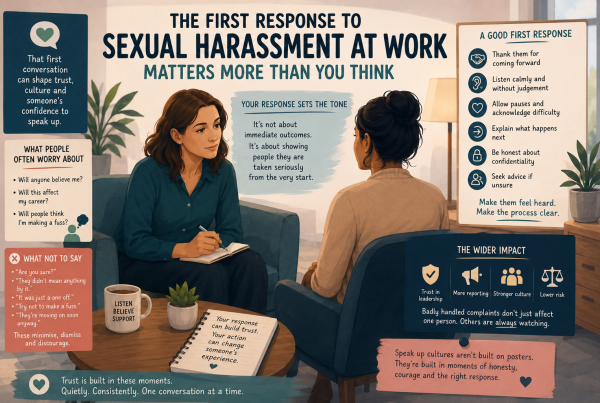
Most people understand that making a complaint can have consequences. They worry about how they will be viewed by colleagues. They worry about being labelled difficult. They worry about damaging relationships at work or becoming known as the person who raised concerns.
These concerns become even more significant when there is a power imbalance.
If the individual involved is a manager, senior leader, influential colleague or client, the perceived risk of speaking up can increase dramatically. People begin weighing up what happened against the potential impact on their career, their reputation and their day-to-day working life.
From the outside, it can be easy to ask why somebody remained silent.
From the inside, remaining silent can sometimes feel like the safest option available.
Delayed reporting is not always about trauma.
Sometimes it is about uncertainty. Sometimes it is about fear. Sometimes it is about workplace politics or a lack of confidence that anything will change. Some people delay reporting because they do not want to go through a formal process. Others have seen how previous complaints were handled and have little faith that raising concerns will lead to a positive outcome.
However, trauma can also play an important role, particularly in cases involving serious sexual misconduct or assault.
One of the misconceptions that still exists is that people who have experienced traumatic events will provide a clear, chronological and detailed account from the moment they first disclose what happened.
That is often not how memory works.
People may remember certain details very clearly whilst struggling to place events in sequence. They may recall specific conversations but forget dates. They may disclose information gradually rather than all at once.
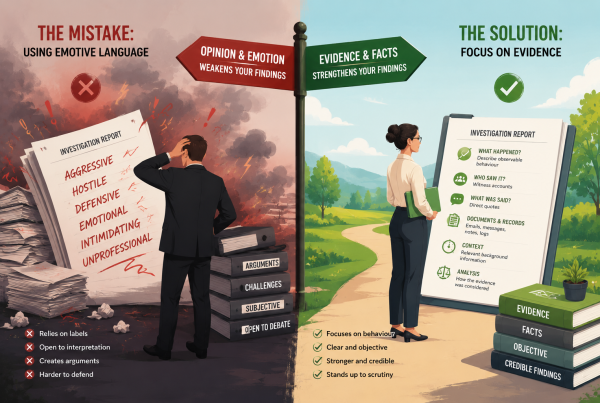
Understanding this is important for anyone involved in workplace investigations. Being trauma aware does not mean accepting allegations without scrutiny or abandoning fairness. It means recognising that delayed reporting and fragmented recall are not unusual and should not automatically be treated as indicators that somebody is being dishonest.
I also think it is important to recognise that workplace investigations and criminal investigations serve different purposes.
When allegations involve potential criminal conduct, individuals may choose to report matters to the police and organisations should take appropriate advice about how workplace and criminal processes interact.
However, workplace investigations are not criminal investigations. The purpose of a workplace investigation is to establish what evidence is available and whether workplace policies, standards or expectations have been breached.
That distinction matters because discussions about delayed reporting are often influenced by assumptions about how victims of crime should behave.
Questions such as “Why didn’t you report it immediately?” or “Why can’t you remember the exact date?” can create an expectation that genuine complaints will always be reported quickly and remembered perfectly.
Real life is rarely that tidy.
The passage of time may affect the evidence available. It may make some allegations harder to establish. It may influence the weight that can be given to certain accounts. However, delay on its own should never be treated as proof that something did not happen.
The reality is that there are many reasons somebody may delay reporting sexual harassment. They may be confused about what happened. They may be frightened of the consequences. They may be worried nobody will believe them. They may be concerned about the impact on their career. They may not yet have the language to describe their experience.
None of those reasons automatically mean an allegation is true.
Equally, none of them mean it is false.
What they do remind us is that human behaviour is complex, particularly when people are navigating experiences that leave them feeling uncertain, vulnerable or afraid.
That is why delayed reporting should never be viewed in isolation. It is simply one part of a much larger picture that needs to be understood carefully, fairly and in context.
At Tell Jane, we support organisations with workplace investigations, sexual harassment prevention and culture reviews. If you would like support handling a complaint, strengthening your reporting processes or building a workplace where people feel respected and safe to speak up, we’d be happy to help.