The Best Investigators Challenge Their Own Thinking
One of the misconceptions I come across when training investigators is the idea that investigations are primarily about asking good questions of other people.
Good questioning matters. The ability to gather evidence, explore inconsistencies and understand different perspectives sits at the heart of any effective investigation. However, the longer I have worked in this field, the more I have come to believe that the quality of an investigation is often determined by a different set of questions altogether.
The most important questions are often the ones investigators ask themselves.
This is partly because investigations are rarely as straightforward as they first appear. Most begin with a complaint, a set of allegations or an account of events that seems relatively clear. As evidence starts to emerge, however, the picture often becomes more complicated. New witnesses appear. Different accounts emerge. Documents raise fresh questions. What initially looked obvious becomes much less certain.
The challenge for investigators is that human beings are naturally drawn towards certainty.
Once we think we understand what happened, we start looking for information that supports that view. We give greater weight to evidence that fits the emerging narrative and can become less curious about evidence that challenges it. Most investigators do not do this deliberately. In fact, many would be horrified to think they were approaching an investigation with a closed mind.
That is precisely why self-reflection matters.
One of the most useful questions an investigator can ask themselves is whether they have genuinely remained open minded throughout the process. Not at the start of the investigation, when everyone intends to be objective, but several interviews in, when patterns are beginning to emerge and conclusions are beginning to form.
It is often at that stage that objectivity becomes most difficult.
A good investigator is not somebody who avoids forming views altogether. That would be impossible. A good investigator is somebody who notices when views are beginning to form and remains disciplined enough to keep testing them.
The same principle applies to evidence.
When reviewing reports, I sometimes notice that evidence supporting a particular conclusion has been explored in great detail whilst evidence pointing in a different direction has received far less attention. This rarely happens because an investigator is trying to influence the outcome. More often, it happens because the investigator has become increasingly confident that they understand what happened.
Confidence can be useful in many situations. In investigations, it can be dangerous.
One of the habits I encourage investigators to develop is asking themselves whether they are applying the same level of scrutiny to all available evidence. Are they testing the evidence they agree with as thoroughly as the evidence they question? Are they exploring alternative explanations with the same curiosity as the explanation they currently believe to be most likely?
The answer to those questions can often reveal more about the quality of an investigation than the eventual finding itself.
I think this is particularly important when evidence is incomplete.
Workplace investigations rarely provide perfect information. Witnesses forget details. Documents are missing. Accounts conflict. Faced with uncertainty, investigators can find themselves filling gaps without realising it. We start connecting dots. We make assumptions about motivation. We infer meaning from behaviour.
Sometimes those assumptions turn out to be correct.
The problem is that assumptions are not evidence.
One of the most valuable disciplines an investigator can develop is the ability to recognise the difference between what they know and what they think may have happened. Investigations require judgement, but good judgement begins with understanding where the evidence ends and interpretation begins.
Another area that deserves careful attention is power.
When people think about power dynamics, they often focus on organisational hierarchy. Managers have power. Senior leaders have power. Employees may feel less able to challenge those above them.
Whilst all of that is true, power can appear in many different forms. Length of service, professional reputation, personal influence, technical expertise and social relationships can all shape how people experience workplace situations and how comfortable they feel speaking up.
Good investigators understand that evidence does not exist in a vacuum. The context surrounding that evidence often matters just as much as the evidence itself.
Finally, one of the questions I encourage investigators to consider is whether they have looked beyond the accounts of the complainant and respondent.
Most workplace investigations begin with two competing versions of events. The temptation is to focus heavily on deciding which account is more persuasive. However, the strongest investigations are usually built on a broader evidence base.
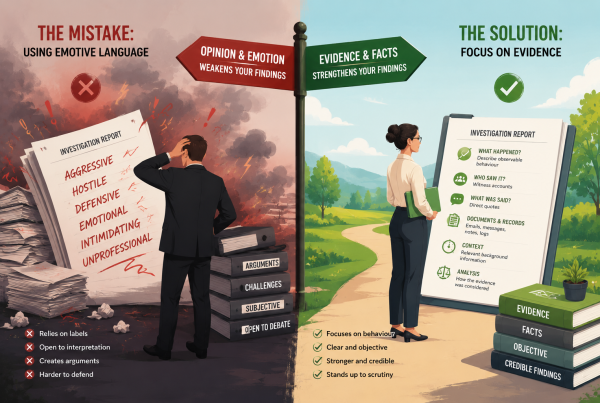
Documents, emails, messages, witness evidence, previous concerns, organisational context and contemporaneous records often provide valuable insight. The more an investigation relies solely on competing personal accounts, the more difficult it becomes to reach findings with confidence.
What strikes me after years of conducting investigations is that the best investigators are rarely the most confident people in the room.
They are often the most curious.
They remain open to the possibility that they may be wrong. They continue testing their thinking long after others have settled on an explanation. They understand that objectivity is not something you achieve once at the beginning of an investigation. It is something you have to keep returning to throughout the process.
Perhaps that is why the most important questions in an investigation are not always the questions asked in interviews.
Sometimes they are the questions investigators ask themselves.
At Tell Jane, we support organisations with workplace investigations, investigator training and quality assurance. If you’re looking to strengthen investigation capability within your organisation or would like support with a complex case, we’d be happy to help.