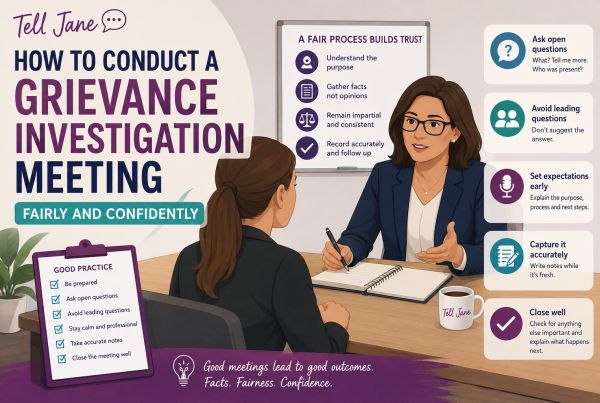
This is a question that comes up a lot, especially in smaller organisations where resources are tight. Many HR teams and business leaders wonder if the person investigating an allegation can also be the one making the disciplinary decision.
It matters because mixing these roles can affect fairness, the credibility of the outcome, and even legal defensibility. Getting it right helps employees feel the process is fair, protects your organisation from challenge, and ensures the investigation produces clear, actionable evidence.
In this blog, we’ll cover best practice guidance on separating roles, the difference between disciplinary and grievance investigations, when it might be unavoidable to combine roles, how to mitigate bias if roles are combined, and some real-world examples of risks. By the end, you’ll have clarity, confidence, and legal awareness. For the wider process, you can also check our disciplinary investigations guide.
Why separation of roles is recommended
Best practice guidance is clear: the investigator and the decision-maker should ideally be different people.
There are several reasons for this:
- Objectivity and impartiality: When roles are separate, employees see that the process is fair and neutral.
- Reduced risk of bias: The investigator can focus on gathering evidence, while the decision-maker weighs the facts without prior assumptions.
- Stronger evidence: Independent investigation and decision-making produce clearer, more defensible reports.
Pitfalls of combining roles include:
- The investigator may develop assumptions about the employee’s guilt.
- The employee may feel the process is unfair and lose trust in HR or leadership.
A simple example: if the same manager both gathers evidence and decides the outcome, it can be harder to defend the process in a tribunal or grievance review. Separation protects both the employee and the organisation.
The difference between disciplinary and grievance investigations
It’s worth clarifying that disciplinary and grievance investigations serve different purposes, which affects who should be involved and how roles are separated.
- Disciplinary investigation:
- Looks at alleged misconduct by an employee.
- Focus is on gathering factual evidence to determine whether a rule, policy, or standard has been breached.
- Outcome may lead to a disciplinary decision.
- Looks at alleged misconduct by an employee.
- Grievance investigation:
- Investigates a complaint raised by an employee, such as bullying, harassment, or unfair treatment.
- Focus is on understanding the employee’s concern, assessing evidence, and recommending solutions.
- Outcome may be remedial rather than punitive.
- Investigates a complaint raised by an employee, such as bullying, harassment, or unfair treatment.
Why it matters for role separation:
- In disciplinary cases, combining investigator and decision-maker increases risk of bias against the employee under investigation.
- In grievance cases, combining roles could undermine trust in the process and affect perceptions of fairness, especially if the same person investigates the complaint and recommends remedial action.
By understanding this distinction, you can decide more confidently when separation is essential and how to adapt if resources are limited.
When the same person might be used (small business reality)
Of course, best practice isn’t always possible. In smaller organisations, resources are limited. There may only be one HR professional or manager available to manage the process.
Legally, there is no absolute prohibition on the same person investigating and deciding. Sometimes combining the roles is unavoidable. Examples include:
- A small team with a single HR contact.
- A business with no access to external consultants.
- Emergency situations requiring swift decisions.
Even when this is the case, transparency is key. Make sure employees understand who will be involved and how fairness will be maintained. Document your steps carefully to show that every effort has been made to act objectively.
How to avoid bias if roles are combined
If you do need to combine roles, there are ways to minimise bias and keep the process robust:
- Separate evidence gathering from decision rationale: Keep your factual notes distinct from any conclusions or recommendations.
- Independent review: Where possible, ask another manager or external consultant to review the findings before a decision is made.
- Transparency: Communicate clearly with the employee about what will happen and the safeguards in place.
- Stick to facts: Map each question to the allegations, focus on behaviours, and avoid opinions.
- Document everything: Clear notes on the evidence and reasoning for decisions are invaluable if the process is later challenged.
For example, you might investigate an allegation, gather all witness statements and documentation, and then draft your recommendation. Before issuing a disciplinary outcome, a second manager or HR consultant reviews the report to ensure neutrality.
Real-world examples of risks
Combining investigation and disciplinary roles carries real risks. Here are some scenarios:
- Tribunal challenges: An employee can argue that the process was biased because the same person both investigated and decided.
- Grievances: Employees may raise complaints about fairness, particularly if they feel their version of events wasn’t heard objectively.
- Loss of trust: Staff may perceive HR or leadership as opaque, which can affect morale and engagement.
Mini-case examples (anonymised):
- In one small business, a manager conducted an investigation and issued a disciplinary notice. The employee challenged it, claiming the manager had already formed an opinion before interviews. The company ended up needing external support to review the process.
- Another HR professional in a tight-knit team found it hard to remain neutral because they knew both parties well. This affected how evidence was recorded and ultimately required a review to ensure fairness.
These examples show why separation is strongly recommended and why careful planning and documentation are essential if combining roles.
Practical takeaways
A few simple principles will help you manage investigations and disciplinary decisions safely:
Checklist / dos and don’ts:
- Do: separate investigation and disciplinary roles wherever possible.
- Do: map your questions and evidence to the allegations.
- Do: document every step clearly if roles are combined.
- Do: consider an independent review or sign-off.
- Don’t: let assumptions or personal relationships influence the outcome.
- Don’t: skip communicating the process and safeguards to employees.
Following these steps helps you run fair, defensible investigations even when resources are limited. For more guidance on running investigations correctly, see our disciplinary investigations guide.
Separation of investigation and disciplinary roles is best practice because it protects fairness, credibility and legal defensibility. Understanding the difference between disciplinary and grievance investigations is key to deciding when separation is essential.
Even when small businesses need to combine roles, careful planning, transparent communication, focus on factual evidence, and thorough documentation can ensure the process is still fair.
If your organisation would benefit from independent investigation support, or guidance on how to separate roles while keeping the process fair, Tell Jane can help. Explore our disciplinary investigations services or get in touch to discuss your options.