One of the most common misconceptions in workplace investigations is that evidence only means hard proof.
People often assume that unless there is CCTV footage, a written confession, or a perfect paper trail, an investigation cannot go anywhere. In reality, workplace investigations are usually built from multiple sources of evidence considered together.
The role of an investigator is not to prove something beyond all doubt. It is to gather, assess, and test the available evidence fairly so the organisation can make a reasonable and informed decision.
And that evidence can come from many different places.
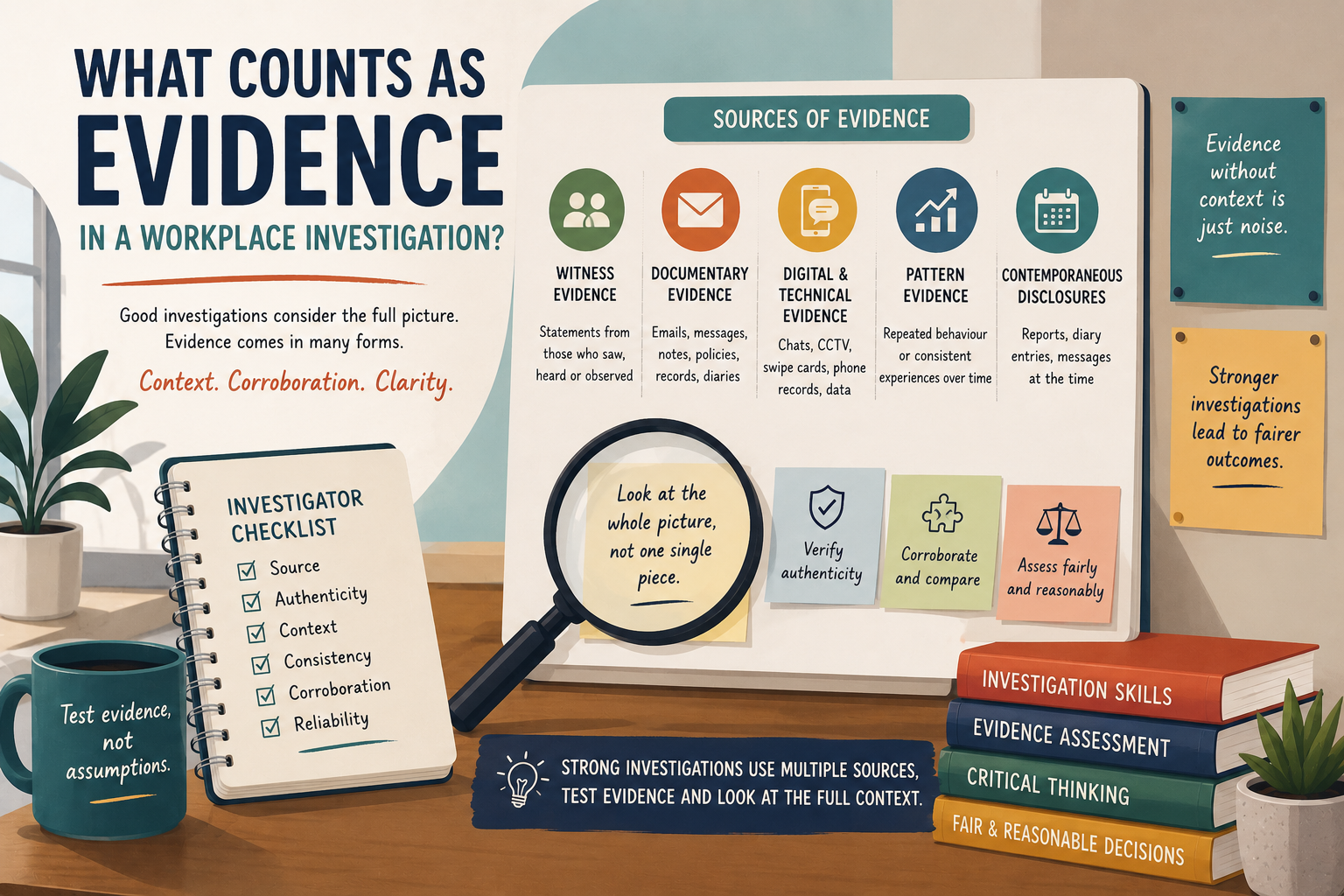
Witness evidence is one of the most common forms of evidence in workplace investigations. This includes people who directly saw an incident, heard conversations themselves, observed behaviour patterns, or noticed changes in team dynamics or conduct.
Witness evidence matters because many workplace issues happen in conversations, meetings, social situations, or environments where there is little formal documentation. But witness evidence also needs careful assessment. People remember situations differently and two individuals can experience the same event in very different ways.
That is why good investigators test consistency, detail, timing, and context rather than simply deciding who they “believe.”
Documentary evidence is another important source of information. This can include emails, WhatsApp messages, Teams or Slack chats, handwritten notes, meeting invites, policies, performance records, HR records, rotas, or diary entries.
This type of evidence can help establish timelines, communication patterns, or whether concerns were raised previously. But documents should rarely be viewed in isolation. Context matters enormously.
A message that looks inappropriate on its own may look very different when viewed as part of a wider conversation thread.
Investigators also increasingly need to think carefully about authenticity. AI generated and manipulated evidence is becoming much easier to create. Screenshots alone are no longer enough to rely upon without proper scrutiny and corroboration.
Some investigations will also involve CCTV footage, swipe card records, recorded meetings, phone records, location data, or social media content. This type of evidence can sometimes help confirm timings, locations, or interactions between individuals.
But digital evidence still needs careful handling. Investigators should consider where the material came from, whether it could have been edited, whether the full context is available, and whether the evidence can genuinely be authenticated.
Good investigations rely on evidence testing, not assumptions.
Sometimes the most important evidence is not one isolated incident but a repeated pattern of behaviour.
For example, multiple employees may describe similar experiences over time. There may be repeated concerns about one individual’s conduct, recurring inappropriate comments, or a consistent management style that several people independently describe in similar terms.
Pattern evidence can be particularly important in bullying, harassment, or culture related investigations where no single incident fully explains the concern.
Hearsay is one of the most misunderstood areas of workplace investigations.
People will often say, “You cannot use hearsay.”
The reality is more nuanced than that.
Hearsay is information someone has heard from another person rather than witnessed directly themselves. For example, “John told me Sarah shouted at him in the meeting.”
The individual giving that evidence did not witness the incident themselves. They are repeating what somebody else said.
The difficulty with hearsay is that it cannot easily be tested in the same way as direct evidence. The investigator cannot properly explore tone, wording, context, or credibility with the original source if they are not directly involved in the process.
Because of this, investigators should not build findings purely on hearsay evidence alone.
However, that does not mean all secondary evidence is irrelevant.
There is an important difference between unsupported hearsay and contemporaneous disclosures.
For example, if someone reported an incident to a colleague immediately afterwards and the colleague can evidence what they were told at the time, when the disclosure happened, and the individual’s presentation or distress, that may still be relevant supporting evidence within the wider investigation.
Similarly, diary entries, messages sent shortly after an incident, or contemporaneous reports can all help support timelines and consistency of accounts.
The key point is that good investigations do not simply accept hearsay as fact. They assess where the information came from, whether it can be tested, and how much weight can reasonably be placed upon it.
Very few workplace investigations are built on one single piece of evidence.
Strong investigations are usually built through corroboration. That means looking at how different pieces of evidence fit together. Witness accounts, timelines, documents, digital evidence, behavioural patterns, and contemporaneous disclosures should all be considered together.
Investigators should always ask whether the evidence supports, contradicts, or partially aligns with other information already gathered.
This is where careful questioning and professional curiosity become critical.
One of the biggest mistakes organisations make is approaching workplace investigations as though they are criminal trials.
The purpose of a workplace investigation is not to prove guilt beyond all doubt. It is to gather enough reliable information for the organisation to make a fair and reasonable decision.
That requires balance, critical thinking, and careful assessment of all available information.
Good investigators avoid jumping to conclusions too quickly, but they also avoid dismissing concerns simply because there is no “perfect” evidence.
Good workplace investigations are rarely built on one dramatic piece of evidence. More often, they are built carefully through multiple sources of information considered together, tested fairly, and assessed in context.
At Tell Jane, we support organisations with workplace investigations, investigator training, and grievance handling support to help leaders manage complex people issues fairly and confidently. Request a brochure to learn more about our work.