Raising a workplace complaint—especially about harassment, discrimination, or bullying—is a big deal. We know most people don’t do it. Why? Because they don’t feel safe.
This is where psychological safety matters. If someone is going to speak up, they need to trust that they’ll be listened to, taken seriously, and—most importantly—not suffer for it. Yet, this is exactly where investigations often go wrong.
What is psychological safety?
Psychological safety means someone feels comfortable speaking up without fear of consequences—whether that’s being ignored, disbelieved, or even penalised.
Now, imagine a junior employee making a complaint about a senior leader. That’s intimidating enough. Add in concerns about their career, reputation, or whether HR will actually be impartial, and it’s easy to see why many people stay silent.
This is why choosing the right investigator is key. It’s not just about process—it’s about making sure people feel safe enough to tell the truth.
Why the investigator matters
Too often, organisations assume any senior HR person or legal professional can handle an investigation. But if the wrong person is in the room, the complainant might shut down—or worse, withdraw the complaint entirely.
1. Seniority & power dynamics
If a senior leader is accused of misconduct, they deserve a process that feels fair. That usually means someone senior needs to oversee the case.
But let’s not ignore the reality: for the complainant, this can be terrifying. If the investigator is too close to leadership—or worse, has a personal relationship with the accused—it raises serious concerns about bias.
2. Representation matters
Let’s be blunt: if a woman has been sexually harassed, a male investigator might not be the right choice. Same goes for cases involving racism—if the investigator doesn’t reflect the lived experience of the complainant, they may struggle to build trust.
It’s not about assuming bias—it’s about recognising that trust matters. If an investigator doesn’t feel like someone who will understand, it can shut the whole process down before it starts.
Why people don’t speak up
Most employees don’t report misconduct. Here’s why:
- They’re scared they won’t be believed
- They worry about career damage – Will they be seen as ‘difficult’?
- They fear retaliation – Even subtle consequences can be enough to keep someone quiet.
- They think nothing will change – If similar complaints have been brushed aside before, why bother?
- The process itself feels unsafe – If the investigation is intimidating or handled badly, it can do more harm than good.
If people don’t trust the system, they won’t use it. It’s that simple.
How to build psychological safety in investigations
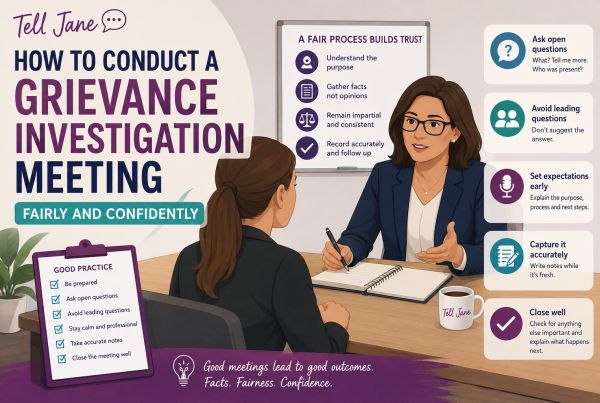
If you actually want employees to come forward, here’s what needs to happen:
 Choose the right investigator – Someone senior enough to have credibility, but not intimidating.
 Consider representation – If the complainant would feel safer with an investigator of a certain gender or background, listen to that.
 Make the process feel safe – No one should fear losing their job or reputation for raising a complaint.
 Train leaders – The first response to a complaint is critical. If managers react badly, the whole thing falls apart.
 Be transparent – People need to trust that their complaint won’t just disappear into a black hole.
Final thoughts
If organisations want employees to speak up, they need to get workplace investigations right. That starts with psychological safety—choosing the right investigator, creating a fair process, and making sure people feel safe enough to tell the truth. At Tell Jane, we train organisations on how to handle workplace investigations properly—with fairness, compliance, and respect. If your team needs support, get in touch.