For many adults, conversations around consent simply were not part of school education in the way they are today.
Depending on age, background and education, sex education often focused on biology, pregnancy and sexual health, with very little discussion around:
- boundaries
- pressure
- coercion
- respectful relationships
- power dynamics
- communication
That matters more than many organisations realise.
Because workplaces are increasingly dealing with the consequences of those gaps through:
- grievances
- investigations
- disciplinary processes
- damaged working relationships
- wider culture concerns
In practice, HR teams and leaders often find themselves trying to manage issues connected to consent and boundaries, even if those words are not always used directly.
Questions around workplace behaviour frequently come back to:
- whether someone felt comfortable
- whether there was pressure or persistence
- whether power influenced the interaction
- whether boundaries were properly understood
- whether behaviour was genuinely welcome
This is why organisations need to think carefully about whether meaningful sexual harassment prevention training can happen without conversations around consent.
Organisations Cannot Assume A Shared Understanding
One of the biggest mistakes employers make is assuming everybody enters the workplace with the same understanding of acceptable behaviour.
They do not.
People arrive with very different experiences, backgrounds and levels of education. Some people have had open conversations around consent and boundaries for years. Others may never have discussed these topics in a meaningful way at all.
That does not excuse inappropriate behaviour. But it does mean organisations should not assume a shared baseline already exists.
What feels obviously inappropriate to one employee may not feel obvious to another.
This becomes particularly important in workplaces with:
- informal cultures
- blurred social boundaries
- heavy after work socialising
- travel
- seniority gaps
- high pressure environments
Most Workplace Harassment Cases Sit In Grey Areas
Many sexual harassment training programmes focus on extreme examples because they are easier to identify.
But most workplace complaints are more nuanced than that.
They often involve:
- repeated comments
- persistent messaging
- jokes presented as banter
- comments about appearance
- unwanted flirting
- social pressure
- blurred boundaries over time
- behaviour minimised as “harmless”
This is where conversations around consent and respectful behaviour become important.
Because many workplace issues are not about somebody deliberately setting out to cause harm. They are about:
- poor judgement
- misunderstanding boundaries
- misuse of power
- failing to recognise discomfort
- assuming silence means comfort
“But They Never Said Stop”
This remains one of the most common misconceptions in workplace harassment cases.
People often assume that if somebody:
- replied politely
- stayed friendly
- laughed along
- continued engaging
then the behaviour must have been welcome.
Workplace dynamics are rarely that simple.
Employees may:
- want to avoid awkwardness
- worry about damaging relationships
- fear career consequences
- feel uncomfortable challenging somebody senior
- try to manage the situation socially
This is particularly important where there is a power imbalance.
A manager messaging a junior employee carries a different dynamic to two peers interacting socially outside work.
That does not automatically make behaviour inappropriate. But context matters.
Understanding that complexity is essential for:
- managers
- HR teams
- investigators
- decision makers
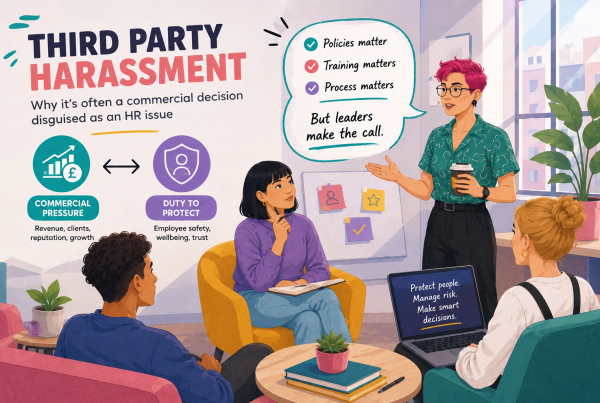
Managers Often Receive Little Practical Guidance
Many managers are promoted because they are commercially strong or technically capable, not because they have been properly trained in:
- workplace boundaries
- power dynamics
- respectful communication
- harassment risk
- handling sensitive situations
Organisations then expect them to navigate complex interpersonal situations using “common sense”.
That creates risk.
One person’s “harmless compliment” may feel very different to somebody whose manager controls:
- progression
- visibility
- opportunities
- workload
- reputation
Without practical training and discussion, organisations often leave too much open to interpretation.
Why Consent Conversations Matter In Prevention Training
Effective sexual harassment prevention training cannot simply focus on policy wording or legal definitions.
Employees need practical understanding of:
- boundaries
- pressure
- persistence
- power
- respectful communication
- digital conduct
- social dynamics
- recognising discomfort
- when behaviour becomes unwelcome
Managers also need support understanding:
- how power affects interactions
- why people may not directly object
- why delayed reporting happens
- how seemingly minor behaviour can escalate over time
Without these conversations, organisations risk treating harassment prevention as a compliance exercise rather than a behavioural one.
This Matters For Investigations Too
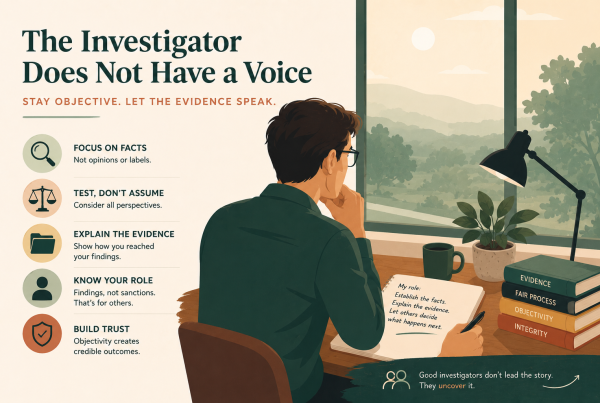
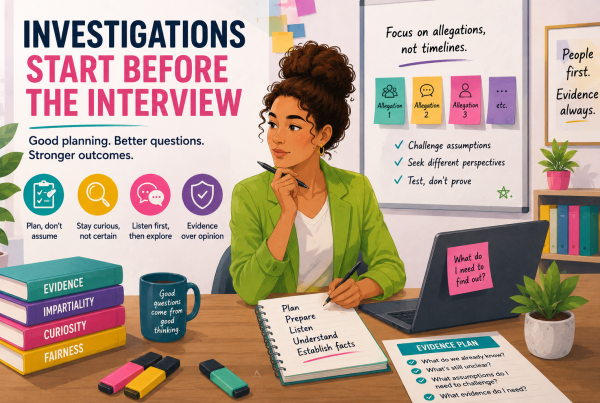
Understanding consent, power and human behaviour is equally important for those managing complaints.
Poor investigations often rely on overly simplistic assumptions such as:
- “Why didn’t they say no?”
- “Why did they keep replying?”
- “Why didn’t they report it sooner?”
- “Why were they still friendly afterwards?”
Human behaviour is often more complicated than that, particularly where professional relationships, careers and reputations are involved.
This is why context aware and trauma aware approaches matter in workplace investigations.
Creating Better Workplace Baselines
Workplaces cannot assume everybody arrives with the same understanding of consent, boundaries and respectful behaviour.
That is why organisations need clearer conversations, better training and stronger behavioural expectations.
Not to infantilise employees, but to create a more consistent baseline across the organisation.
This matters not only for employees, but also for:
- managers
- HR professionals
- investigators
- senior leaders
- decision makers
Because when organisations avoid these conversations entirely, they often end up addressing the consequences later through formal complaints, investigations and culture repair work.
You may have seen the widely shared “Tea and Consent” video, which helped introduce consent conversations in a simple and accessible way:
Tea and Consent video
How Tell Jane Supports Organisations
At Tell Jane, we support organisations with:
- sexual harassment prevention training
- workplace investigations
- culture reviews
- leadership support
- speak up culture development
- trauma aware and practical manager training
Our approach focuses on helping organisations move beyond compliance and build workplaces where people feel respected, clear on behavioural expectations and confident raising concerns when something does not feel right.
If your organisation is reviewing its approach to workplace conduct, harassment prevention or leadership capability, explore our services at Tell Jane.