One of the most common questions I get asked by new investigators is, “What questions should I ask?”
It’s an understandable question. After all, the interview is where the evidence is gathered, so surely having the right questions is the key to a good investigation.
The reality is a little less exciting than that.
There is no magic list of investigation questions. The same question can be useful in one investigation and completely unhelpful in another. What matters is not having the perfect question ready to go. What matters is understanding what you need to find out and thinking carefully about how you’re going to get there.
In my experience, most poor investigation interviews are not caused by poor questioning. They are caused by poor preparation.
The strongest investigators spend less time worrying about the next clever question and more time thinking about the evidence they need, the gaps they need to fill and the assumptions they need to avoid.
Because whether we like it or not, the questions we ask shape the evidence we get.
Most Bias Creeps In Before The Interview Starts
When people talk about bias in workplace investigations, they often focus on what happens in the room.
They think about leading questions, challenging witnesses too aggressively or jumping to conclusions too quickly.
Those things matter, but in my experience bias often appears much earlier than that.
It starts when we read a complaint and begin forming a view about what might have happened. It starts when we become attached to a particular explanation before we’ve tested the alternatives. It starts when we assume we know what we’re looking for before we’ve gathered all of the evidence.
None of this is deliberate. It’s human.
The problem is that once we think we know what happened, it becomes surprisingly easy to start asking questions that support that view rather than challenge it.
That is why planning matters so much.
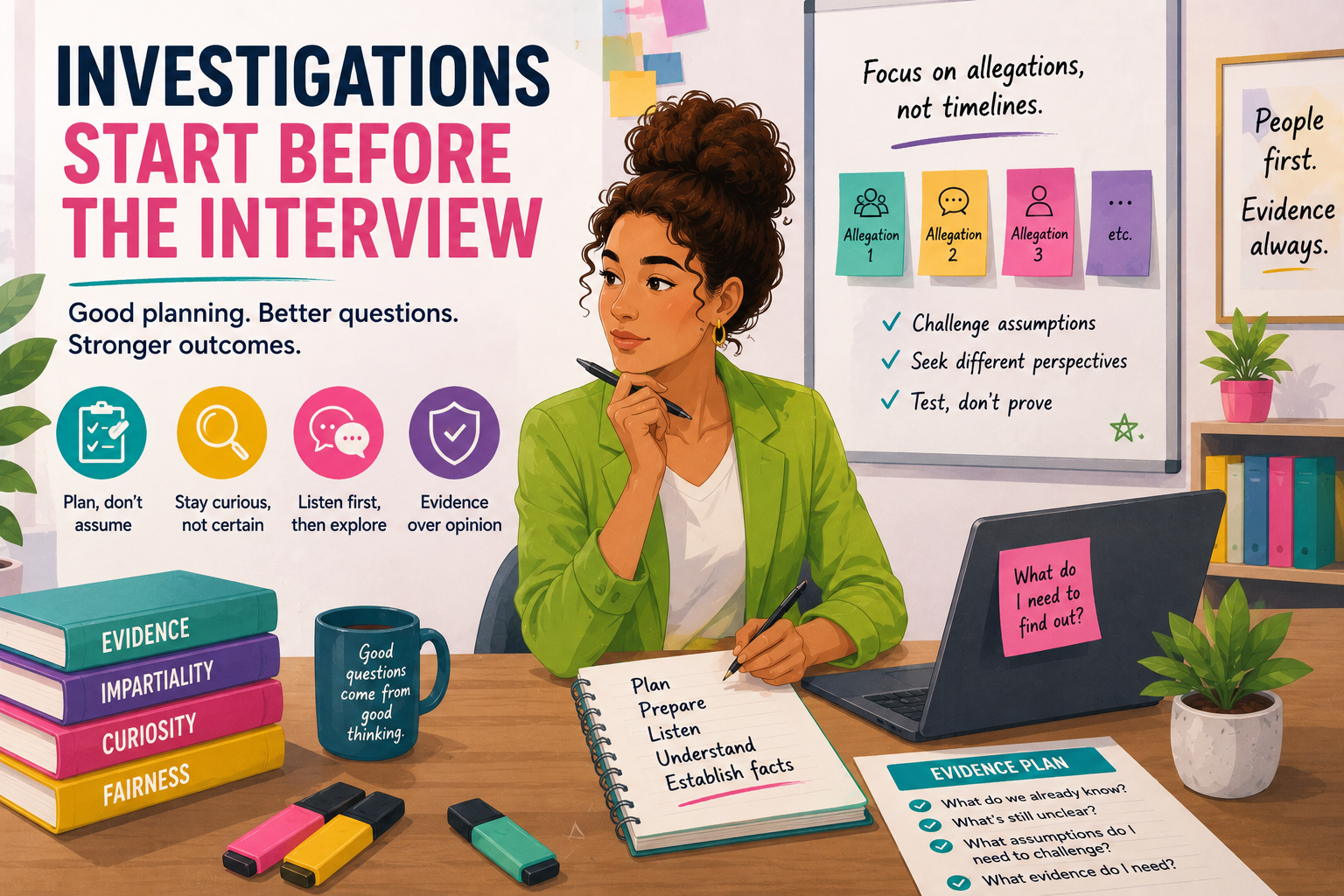
A good interview plan is not simply an organisational tool. It is one of the best safeguards we have against our own assumptions. It forces us to slow down, think carefully about the evidence we have and identify what still needs to be explored.
Good planning helps us stay curious for longer.
A Good Interview Plan Helps You Listen
One of the biggest misconceptions about investigation interviews is that they are won or lost by the quality of the questions.
In reality, they are often won or lost by the quality of the preparation.
Most investigators have experienced that moment where they are listening to an answer, making notes, thinking about what has just been said and simultaneously trying to work out where to go next. Whilst all of that is happening, it becomes remarkably easy to miss something important.
A good interview plan removes much of that pressure.
By the time I walk into an interview, I want to know what evidence I already have, what evidence I still need and what areas I need to explore further. That doesn’t mean the interview becomes scripted. If anything, the opposite is true.
Because I’ve already done the thinking, I have more capacity to listen properly to what is being said.
I can spot gaps in the evidence. I can notice when something doesn’t quite make sense. I can follow an unexpected line of enquiry without worrying about losing my place.
The irony is that planning doesn’t make investigators more rigid. It gives them the freedom to be more flexible.
Every Assumption Has Consequences
The biggest threat to a good investigation interview is not usually hostility, dishonesty or a difficult witness.
More often, it is the investigator’s own assumptions.
Once we think we know what happened, even tentatively, it becomes difficult not to look for evidence that supports that view. We spend longer exploring one explanation than another. We become more interested in information that confirms our thinking and less interested in information that challenges it.
Most investigators don’t do this deliberately. Many are completely unaware it is happening.
This is often where poor questions begin to appear.
An investigator who believes somebody has been excluded may start asking questions about why they were excluded. An investigator who believes a manager behaved inappropriately may start exploring the impact before they have fully established what happened.
Before long, assumptions begin to find their way into the interview.
The purpose of an investigation is not to prove a theory. It is to test one.
That is why I always encourage investigators to think carefully about what they know, what they think they know and what still needs to be established.
Those are three very different things.
Organise Questions Around Allegations, Not Timelines
One piece of advice that is often given to investigators is to work through events chronologically.
Sometimes that works perfectly well.
Quite often, however, it doesn’t.
Most workplace investigations are not ultimately analysed by timeline. They are analysed by allegation.
If I am investigating allegations of bullying, exclusion and inappropriate comments, that is how I will structure my findings. It is how I will assess the evidence and it is how I will write my report.
For that reason, I often find it more useful to structure interviews in the same way.
Rather than jumping backwards and forwards through months of events because they happened in a particular order, I can focus on gathering all of the evidence relating to a specific allegation before moving on to the next.
It usually makes more sense for the interviewee, it creates clearer evidence and it makes the analysis process considerably easier later on.
Chronology has its place, but it is not always the most efficient way to gather evidence.
Not Every Inconsistency Means Someone Is Lying
One of the quickest ways for an investigation to go off course is to assume that every inconsistency is evidence of dishonesty.
People remember things differently.
They notice different details. They attach significance to different moments. Two people can sit in the same meeting and leave with genuinely different recollections of what happened.
That does not automatically mean one of them is lying.
A witness getting a date wrong is not the same thing as a witness being dishonest. Equally, somebody remembering a conversation differently to another person does not automatically mean one account is true and the other is false.
Good investigators approach inconsistencies with curiosity rather than suspicion.
Instead of asking, “Who is telling the truth?” they often start by asking, “What might explain this difference?”
Sometimes the answer is dishonesty.
More often, the answer is considerably more ordinary than that.
People Give Better Evidence When They Feel Able To Speak
Investigation interviews are not easy conversations.
People may be nervous, upset, frustrated or worried about the consequences of speaking openly. They may be discussing events they have thought about repeatedly or events they have tried very hard not to think about at all.
The investigator cannot control how somebody feels.
What they can do is create the conditions for a good conversation.
That means explaining the process clearly. It means listening properly. It means allowing people time to think and resisting the urge to jump into every silence.
Some of the most useful evidence emerges when people are simply given the space to finish their thoughts.
One of the most effective prompts in an investigation interview is also one of the simplest.
“Tell me more about that.”
Not because it is clever, but because it allows the interviewee to keep talking without being directed towards a particular answer.
Better Planning Leads To Better Evidence
People often look for the perfect investigation question.
In reality, there usually isn’t one.
The strongest investigation interviews are rarely the result of clever questioning. They are usually the result of careful preparation, clear thinking and a willingness to remain open minded for longer.
A good interview plan helps investigators avoid assumptions, gather better evidence and stay focused on the questions that actually matter.
The questions themselves are important.
But the thinking that happens before the interview is often what determines the quality of the evidence that comes out of it.
At Tell Jane, we carry out independent workplace investigations and train organisations to conduct investigations that are fair, thorough and evidence based. Whether you need support with a complex case or want to strengthen the skills of your internal investigators, we’d be happy to help.
Get in touch to find out more.